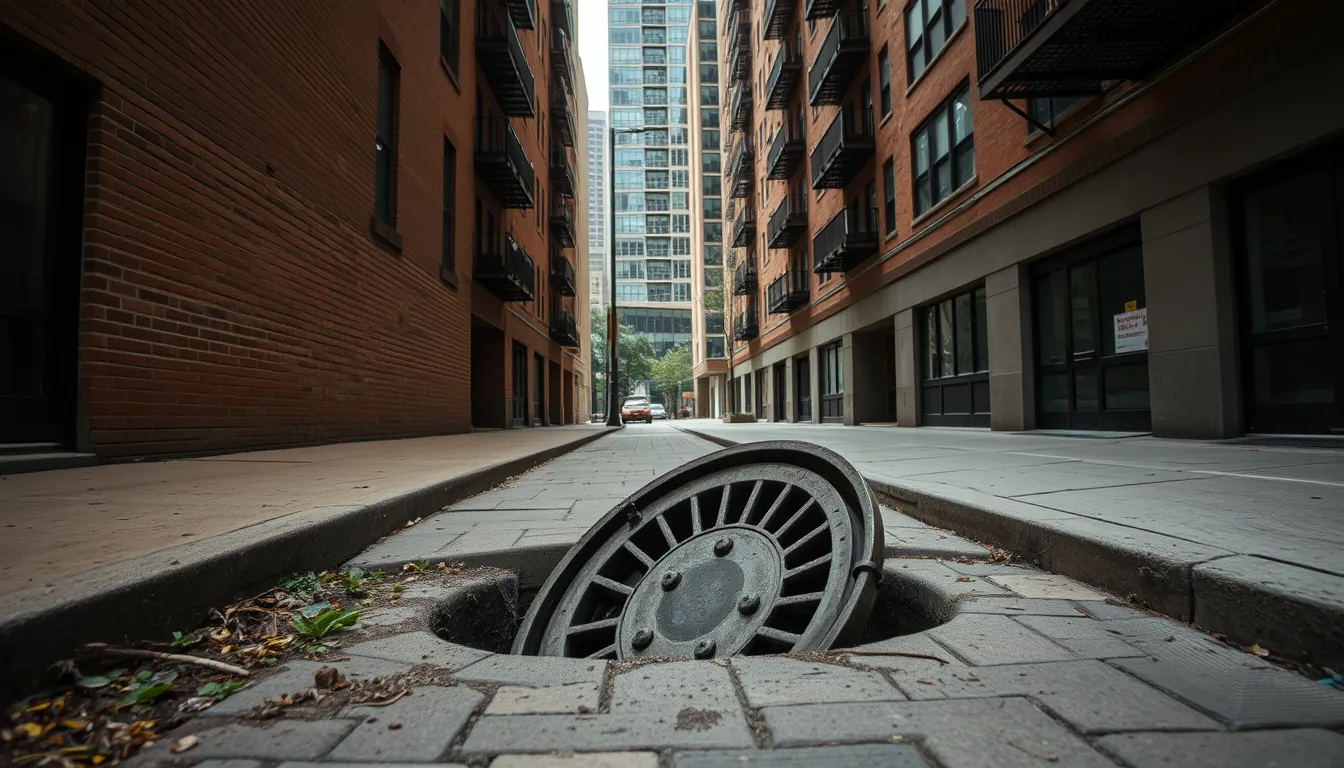
Sewer Line Repair in Uptown, Dallas
Uptown is a public improvement district with the pipe density to match its building density.
- Camera footage and written scope before any price
- City of Dallas permits handled when the main is touched
Uptown sewer callback
Tell us what is backing up. We call back to confirm a window.
The district and its borders
Uptown is both a public improvement district and one of the densest residential areas in Dallas. US 75 forms the eastern edge, Blackburn Street the northeast, the Katy Trail the northwest, and Cedar Springs Road with Bookhout Street the western boundary. Spur 366 closes the south, and downtown sits directly below it.
Shared laterals, shared problems
Much of the housing here is multi-family, which means laterals serve more fixtures than a single-family line was designed for, and some buildings share a private collection line before the public main. When a backup happens in a building like this, the first question is which segment failed: the building’s internal line, the shared private line, or the public main.
Commercial kitchens and grease
The restaurant density along the Cedar Springs and McKinney corridors puts grease into lines that also carry residential waste. Grease cools and deposits on the pipe wall, narrowing the bore until a routine flow becomes a blockage. Jetting clears it, but the deposit returns unless the interceptor upstream is maintained.
Permits in a dense district
City of Dallas permitting governs, and Dallas Water Utilities inspects main connections. Work in an alley or under a sidewalk typically needs right-of-way approval, and that timeline should be in the schedule, not discovered mid-job. Buildings in a PID may also have district-level rules about restoring the streetscape.
Access and scheduling on tight blocks
Alley access, loading zones and street parking all shape when a crew can work here. A job that needs a machine parked for six hours is a different proposition in Uptown than on a residential street. Camera work and jetting are usually same-visit; excavation may need a scheduled window agreed with the building.
Building managers and the paper trail
Multi-family work needs a paper trail because the cost is often shared. A camera report with distances lets a building manager demonstrate to residents or an association exactly where the failure sits and who owns it. Without that, the conversation stays at the level of who called first.
The Katy Trail edge and older service lines
Properties backing onto the Katy Trail sit on ground that has been regraded across the corridor’s history. Service lines near that edge sometimes show old repairs in mixed materials. A camera pass that notes each material transition is what tells a manager which segment belongs to the building and which belongs to the utility.
Grease traps, hauling and the line behind them
A kitchen line that keeps blocking usually has an interceptor upstream that is undersized or not being pumped on schedule. Clearing the pipe without addressing the trap is a repeat visit waiting to be scheduled. Building managers should be able to produce the pumping record; if there is not one, that is the first fix, and pipe work comes after it.
Camera first, because a shared line has shared costs
On a multi-family block, whoever pays for the repair depends entirely on where the failure sits. A camera pass with distances settles that in under an hour, and it also shows whether the segment is the building’s private line, a shared lateral, or the public main. Getting that wrong means one party paying for work they do not own, which is exactly the kind of dispute that turns into a delay.
ZIP codes commonly associated with Uptown: 75204, 75201, 75219.
Uptown sewer questions
What defines the boundary of Uptown in Dallas?
US 75 to the east, Blackburn Street to the northeast, the Katy Trail to the northwest, Cedar Springs Road and Bookhout Street to the west, and Spur 366 to the south.
Who fixes a shared private sewer line in a multi-family building?
The building or its association owns anything before the public main. A camera run establishes where the failure sits so responsibility is clear before work begins.
Why does grease keep coming back in Uptown restaurant lines?
Because jetting clears the pipe but does not stop the source. If the grease interceptor upstream is not serviced, the deposit reforms and the blockage returns.
Do alley repairs in Uptown need a city permit?
Work in the right-of-way, including alleys and sidewalks, needs City of Dallas approval. Plan the timeline for it rather than treating it as a formality.