Sewer Line Repair in Dallas, TX
Dallas laterals fail on Blackland clay, and the fix is decided by footage rather than by guesswork. We look first, then tell you what the pipe actually needs.
- Sewer laterals, not general plumbing
- Camera footage shared with you
- Trenchless where the pipe qualifies
- Camera footage and written scope before any price
- City of Dallas permits handled when the main is touched
Request a sewer callback
Tell us what is backing up. We call back to confirm a window.
What this site is for
Dallas has a sewer problem that most cities do not have in the same form. The ground here is Blackland Prairie clay, which swells when it takes on water and shrinks as it dries. Every joint in a buried lateral is worked by that cycle twice a year, and the pipes that were installed before 1975 were never designed for it.
So a Dallas sewer call is rarely a simple clog. It is usually one of three failures: a clay tile joint that has opened and let soil in, a cast iron pipe that has rusted through at the crown, or a section of Orangeburg fibre pipe from the 1950s that has flattened into an oval and cannot pass solids any more. Each one looks similar from the kitchen sink and completely different on a camera.
That is why this site starts with inspection. A repair quoted before anyone has seen the pipe is a price built on an assumption, and in this city the assumption is wrong often enough that it is not worth making.
How we work out what is actually wrong
A push camera goes down the lateral from the cleanout to the main. On the recording we can see the material, the diameter, every joint, any root mass, any standing water and any place the pipe has lost its shape. Distances are recorded so the defect can be marked on the ground above it. That recording is yours to keep.
From the footage, the repair falls into one of four categories. A short break in otherwise sound pipe is a spot repair. A run with joint gaps or root intrusion but a round, structurally sound host pipe can be lined in place. A brittle, deformed or Orangeburg line can be burst and replaced with high-density polyethylene through the same path. A line that has lost its grade, or holds a belly over a long stretch, has to be replaced at a reset grade, because lining a sag leaves the sag in place.
None of that is guesswork, and none of it requires tearing up a whole yard by default. It requires somebody to look.
Why the same three failures keep appearing in Dallas
Cast iron installed between roughly 1920 and 1975 corrodes from the inside. Waste water runs along the bottom and air sits above it, so the crown thins first. On camera, a crown failure looks like a dark channel across the top of the pipe with the invert still visible below it. By the time the line backs up, the wall is often already perforated, and cabling it just opens a path through the scale for a few months.
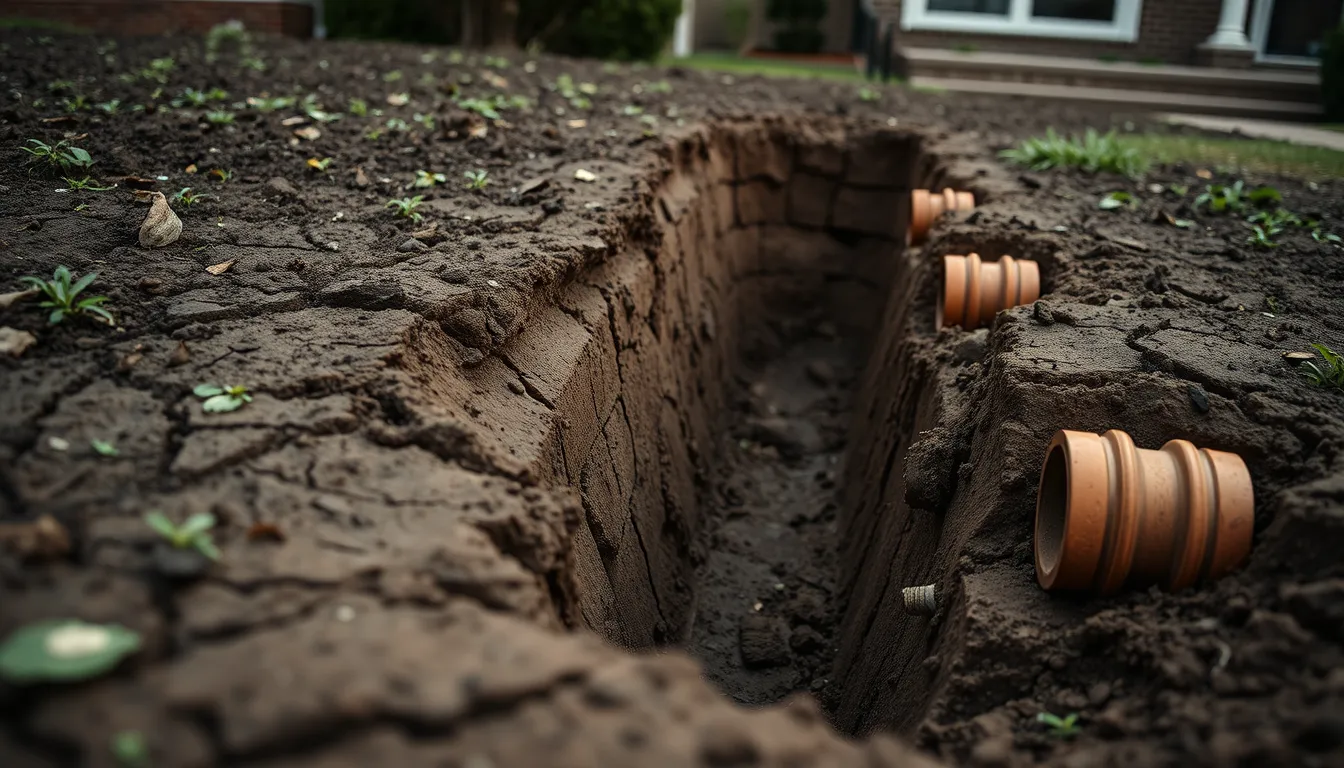
Clay tile from the same era fails at the joints instead. The clay soil movement opens a gap, soil washes in, and the pipe loses support underneath. That produces a sag, and a sag holds water and solids even after the line has been cleared. This is the failure that turns into a repeat call every season, and it is the one homeowners most often describe as "it keeps coming back".
Orangeburg is the third. It was sold from the late 1940s into the 1950s as a cheap alternative to iron, made from wood pulp and coal tar pitch. It absorbs water and deforms under load until the cross-section is a slit. Nothing about it can be repaired, because there is no sound material to bond to and no round shape to line. When the camera shows Orangeburg, the conversation moves directly to replacement.
What the repair methods actually mean
Open-cut replacement opens a trench along the lateral, removes the old pipe, sets new pipe on fresh bedding at the correct grade, and backfills in compacted lifts. It is the right answer on shallow runs in open ground, and it is the fallback whenever the pipe cannot be lined or burst.
Pipe bursting pulls a bursting head through the old pipe, fracturing it outward, while dragging new HDPE behind it along the same path and grade. It needs a launch pit and a reception pit, and it keeps the yard between them intact. On a Dallas lot with a driveway over the line or a mature pecan in the front garden, that difference in disturbance is usually the deciding factor.
Cured-in-place lining turns the existing pipe into the new pipe by curing resin against its inner wall. It closes joint gaps and seals out roots permanently, and it requires only small access points. It does not fix a belly, it does not correct a wrong slope, and it cannot be installed in a pipe that has flattened.
Camera inspection is not a repair method, but it is the step that chooses between them. Skipping it is how a homeowner ends up paying for a method that does not match the failure.
What people call us about
Backups that come back
A stoppage that clears with a cable and returns within weeks points at a broken joint or a belly. The pipe is not blocked, it is damaged.
Gurgling floor drains
When the washer empties and the floor drain answers, the restriction is downstream of the house and inside the lateral.
Sewage at the cleanout
The cleanout is usually the lowest opening on the line, so it surfaces a blockage that the toilets have not reached yet.
A soft strip in the lawn
A permanently damp or unusually green line across the yard can mark a leaking joint or a collapsed section below the surface.
Slow drains everywhere
One slow fixture is a trap. Every fixture slow at once is a main-line restriction or a lateral that has lost its bore.
Sewage smell indoors
A smell without a visible backup often means a dry trap or a vent issue, but a persistent smell near a floor drain can indicate seepage under the slab.
Sewer work we do in Dallas
Sewer Line Repair
A failed lateral under a Dallas lawn is a digging problem before it is a plumbing problem.
Trenchless Sewer Repair
Trenchless means the pipe is replaced through the pipe, and the yard is mostly left alone.
Sewer Line Replacement
Replacement is the right call when the pipe has failed as a system, not at one joint.
Sewer Camera Inspection
The camera is not the repair. It is the evidence that decides which repair you need.
Orangeburg Pipe Replacement
Orangeburg was never meant to carry a sewer for seventy years, and in Dallas it has not.
Cast Iron Sewer Replacement
Cast iron does not crack first. It rusts from inside until the top of the pipe is gone.
Pipe material by build era
The age of a Dallas house narrows down what the camera is likely to find. It does not replace the inspection, because later repairs create mixed runs, but it tells you what to expect before anyone arrives.
Pre-1920
Vitrified clay and occasional brick sections. Rarely found as a full run today, but partial survivals show up during renovation.
1920s-1970s
Cast iron and clay tile dominate. Cast iron shows crown loss; clay shows open joints and offsets. Both are at or past service life.
1950s
Orangeburg fibre conduit appears as a cheap alternative. It deforms rather than cracks and cannot be patched or lined.
Post-1975
Schedule 40 PVC becomes standard. It does not corrode, but joints separate and bedding failures create bellies.
What sewer work costs in Dallas
Published Dallas cost guides put traditional trench replacement at roughly $52 to $67 per linear foot, with some all-in figures reaching $150 per linear foot once materials, labour and restoration are counted. Trenchless sectional lining is commonly reported between $900 and $2,500 for a short reach. Spot repairs are quoted per job rather than per foot.
Those numbers are anchors, not prices. The variables that move a real total are access, depth, restoration and permit scope. A lateral in an open side yard costs less than the same length under a finished patio. A run deeper than eight feet needs shoring and costs more to dig. A driveway crossing adds concrete restoration that can rival the pipe work itself. Work that reaches the public main needs a City of Dallas permit and inspection.
Ask for each of those as a separate line on the quote. A single blended number hides which one is driving the cost, and it makes the comparison between two contractors meaningless.
Dallas sewer questions
Who pays for the sewer lateral in Dallas, the homeowner or the city?
The homeowner is generally responsible for the lateral running from the house to the property line or the connection at the city main. Dallas Water Utilities owns the public main and the connection point. Where exactly that line sits is worth confirming before a repair, because it decides who pays and who permits.
How much does sewer line repair cost in Dallas?
Published Dallas guides put traditional trench replacement around $52 to $67 per linear foot, with all-in figures sometimes cited up to $150 per linear foot. Trenchless sectional lining is commonly reported between $900 and $2,500 for a short reach. Those are market ranges, not quotes; depth, access and restoration move the real number.
Why do Dallas sewer lines fail so often?
Dallas sits on Blackland Prairie clay that swells when wet and shrinks when dry, flexing every joint in a lateral twice a year. Combined with cast iron installed before 1975 and Orangeburg fibre pipe from the 1950s, the housing stock here produces a high rate of joint separation, crown loss and deformation.
Can a sewer line be repaired without digging up the yard?
Often yes. Sectional lining and pipe bursting both work from small access pits rather than a continuous trench, which matters on Dallas lots with mature trees, irrigation and driveways. The camera decides whether the pipe is round enough and sound enough to qualify.
Do I need a permit for sewer work in Dallas?
Work that reaches the public main or the city right-of-way requires a City of Dallas permit, and the contractor pulls it. Repairs entirely on private property still have to meet the plumbing code, and the contractor carrying the work must hold a Texas plumbing licence.
What should I do first when sewage backs up?
Stop using water-heavy appliances and do not open the cleanout while waste is standing in the line. Keep people and pets away from any wet patch in the yard, then call and describe which fixtures are affected and whether the backup clears on its own.
Does homeowners insurance cover a Dallas sewer line?
A standard Texas homeowners policy usually excludes the lateral itself, the excavation and landscaping restoration. Some carriers sell a service line endorsement that covers exterior buried pipe up to a limit. Interior damage from a sudden backup may be covered depending on the policy.
How long does a sewer repair take?
A camera inspection takes under an hour. A spot repair or sectional lining is usually a single day. A full replacement from house to main typically runs one to two working days, plus cure time where a liner is used.
Dallas areas we cover
We work across the city, from the pre-war blocks of Oak Cliff and East Dallas out to the mid-century subdivisions of Lake Highlands and Far North Dallas.
- Sewer line repair in Oak Cliff
- Sewer line repair in East Dallas
- Sewer line repair in Lakewood
- Sewer line repair in Lake Highlands
- Sewer line repair in Preston Hollow
- Sewer line repair in Uptown
- Sewer line repair in Downtown Dallas
- Sewer line repair in Deep Ellum
- Sewer line repair in Bishop Arts
- Sewer line repair in North Dallas
- Sewer line repair in Swiss Avenue
- Sewer line repair in Winnetka Heights
- All service areas